Tag Archives: Writing

Wrapping Up

It’s a wrap!

The last four weeks have been quite productive for all five of us. We all came in with different goals and finished happy with what we accomplished. I went out of alphabetical order for this wrap-up to finish with Matt’s mini guest post about his project. Here’s what everyone has to say!

Anne

Even though I made almost no progress the last two weeks, I have had a meaningful project here and a jump-start. 

Laura

I didn’t meet any of my original goals, but I got a lot done and finally got an idea for a mystery novel (something I’ve always wanted to write). I continued to work on a short story I started forever ago, and I got some solid revisions done.

Lisa

Overall, I didn’t finish a story, but I got some work done, which is so much better than no work. I also came up with some ideas for additional projects, so I’m satisfied that these four weeks were a success!

Robert

This week I wrote 1,087 words. For the four weeks I wrote 5,254 words. My plan was to write 7,000 words, so I made 75% of my goal. I’m pretty happy with that — I didn’t expect to write that much. I mostly wrote on the weekend because the work week is too busy. This project has re-energized my novel writing — I was somewhat stalled for a while, but now I have some fresh ideas and a pace that I can keep up through the semester. I hope to finish the draft of the novel by the end of the semester, around 85,000 words, and do the editing during the summer.

Matt

After darned close to eighteen months’ steady work on a long-suspended project, I used an invitation to Laura Power’s four-week writing group as an excuse to set myself a deadline. By the end of January, I would have a readable first draft of my book. There are a couple of reasons why this is an important event for me.

One is that this book, which in my head I think of as a novel, is not a novel. It is made of several parts, most of them prose, some of them comics, and some fake research. One of the pieces of prose is novel-length on its own. That was the first part, and it was written almost twenty years ago (fortunately for everyone, it has changed a lot since then). The pieces evolved over time; another prose story a year later, a few comics four years after that, then a whole bunch of comics over a two year period. I knew they were related, but I was unsure about the nature of their relationship.

In 2014, I began to work in earnest on a plan to draw together the disparate elements I had already created. How could they all exist together? What would it look like? What would it take?
I decided that it would take four new stories and a framing device, which is what I’ve been doing for the past year. It’s all one story, but it’s a lot of parts, and bringing it all together means that I can finally step back and look at it as one thing. I can finally start considering all the big questions and figure out what it’s all about.

Shouldn’t you already know what it’s about? you might rightly ask. As usual, glibness saves the day. The human mind loves a binary, so allow me to unapologetically assert that there are two kinds of stories. There are the constructed stories, where your characters and places and plots begin to reveal themselves from lists of attributes. These are the stories that begin as writing exercises. This is not an indictment – these exercises are not only a valuable way of organizing information, they are paths to inspiration. You may start with a topic sentence or an exquisite corpse, but it leads you somewhere and the magic takes over and holy shit you may never have gotten there otherwise! But for me, when I’m writing a constructed story, it’s much easier to ask myself responsible questions like “What does my character want?” and “What are the obstacles that stand in the way of achieving those goals?”

Then there are the stories that just smash you in the face and you never had a chance to figure that stuff out in advance. You sat down to jot a couple of ideas before they got away from you, and the next thing you knew you’d filled twenty-four pages of a legal pad and you can’t stop now to ask where it’s all going. When I’m working in a world like that, which is mostly where I’ve been, I prefer to wait, to trust the thing that wants to come out. After it’s all out, then I’ll try to understand what I’ve made, and what I can do to make it better.

See, this process has involved keeping so many things active in my mind, so many voices coming out of my own head, that it’s finally gotten to be a bit overwhelming. When it existed as a collection of individual stories, I could not stop shifting and folding and pinching them. I had to put them together to make them quiet, so I would finally be able to see the whole.

And I knew it was time to finally share the burden. It is a scary prospect, this weird naked thing that is surely not ready to be seen, but I need other voices. I need people who have not been living inside it, not living with it inside them, to look at it and tell me what they see.
The strangest thing happened. I put the stories all together and suddenly, it became utterly inert. The voices were gone. I looked at this thing and I asked myself, What does it need?, and I had no response. What are you about? Are your characters three dimensional and consistent?

The book was silent.

I sat on it for a couple of days like a hen, but nothing happened. Because I was still holding on to it.

Anticipating the completion of this first draft, I had already lined up a few people who were willing to read it for me. At this point, feeling deeply ambivalent, I decided to try something.

I shared the book with just one of them.

And I waited.

About a day later, it happened. The voices. The obsessive note-taking. The constant onslaught of thoughts! All the parts of my book have started reorganizing in my head, becoming the whole that I’ve been trying to force them to be. I just couldn’t see it. Remember how I said that I needed to be able to take a step back and look at what I made? I believe that the simple act of sharing it with one person achieved that degree of removal that I required. My head is filling back up with questions that need to be answered, and after having felt like I had run out of steam, I’m starting to feel that I will actually be up to the task of taking on the next leg of this journey.

I set myself the challenge of creating a readable first draft. And it is readable, at least in the sense that it is typed and composed mostly of complete sentences. Though I will admit to some small indulgence in sentence fragments. For emphasis.

Is it ready to be shared, in any meaningful way? Probably not, but writing is that curious artistic endeavor that practically requires the work to be shared before it is ready. This is a necessary step, and I truly thank the people who have agreed to be a part of it with me. Know I am aware that the thing I’m about to send you is dense and verbose and probably full of fat that I should have cut out, and perhaps it lacks focus where it shouldn’t, and maybe I’m not sure that the reward is worth the journey. Yet. But I’m working on it, and no matter what comes of this part, sharing it with you is part of my process and I hope you don’t regret it.

For the moment, I’m going to try to enjoy this milestone for what it is. Not an ending, but a goal. A little triumph along the way. Not so very long ago, “readable first draft” seemed almost unattainable, but I got there. So who’s to say I can’t make it the rest of the way?


Good work, everyone! We’ll see you back here for the Summer 2016 group!
Week Four: Winter 2016 Online Writing Group

It’s the final week of our winter writing group, and we’re wrapping up with some great work! Anne, Lisa, Robert, and I started school this week, but we’re still plugging away; it’s easier to write before the student essays start rolling in…

Updates and Week Four Goals:

  • Anne: I am going to continue with my notetaking from Burroughs and other sources. It is working — I’m getting specific ideas and motivation for my WIP [work in progress]. I’m even having the nerve to say that I have a WIP!
  • Laura: I started my outline and this week I’d like to keep working on it; I’d like to get a very rough outline of the whole book done by the end of this week. I don’t usually outline, but a mystery novel is new to me, and I think that something so focused on plot needs better organization than I usually give it.
  • Lisa: This week, I’m hoping to write two pages. It’s been busy, but I’m sticking with it!
  • Matt: For all intents and purposes, I have assembled my first draft. I am more comfortable with some parts than with others. It’s a pretty big milestone and I’m heavy with ambivalence, but trying to give myself the space to actually appreciate the fact that it is a milestone. It’s okay to celebrate, even though I’m not finished. Right? [YES, MATT!!]
    What I want to do this week is prepare some questions, both general and specific, as I regard the manuscript and get ready to share it with my volunteer readers. I’m not interested in burdening them with any thoughts that may color their initial reading experience, but they are all aware that they are test subjects. They’re not reading for pleasure (at least not exclusively?) but for feedback. And I know readers approach that process in different ways, so if anybody actually wants any guidelines or ideas about the sort of feedback I need, I would like to be ready with them. In any case, I will need the questions eventually. Now that I finally know what my story is, I hope to learn what the thing is about. Ask myself all those basic questions that a more responsible author would have asked years ago. But I don’t really like to work that way.
  • Robert: I wrote 958 words in the last week. The first week of school was busy of course! For this last week I will still strive for 250 words a day, 1750 for the week.

I like to read about other writers’ processes, and one of my favorite writer-on-writing is Stephen King. I recommend his book On Writing: A Memoir of the Craft; he writes about his early writing life, the car accident in 1999 (he was hit by a van), and coming back to writing after being physically unable to do it. It’s a great memoir and King has a lot of pearls of wisdom for novice and veteran writers alike.

You can get a glimpse of some of the things he writes about in On Writing in an interview he did with The Paris Review as part of the magazine’s “Art of Fiction” interview series. The Paris Review has been running this series for decades and decades, interviewing writers like Vonnegut, Nabokov, Angelou, and so many more. You can get a collection of some of the best, or you can do a quick Google search and find the one you’re looking for.

Paris Review Art of Fiction

Happy reading, and good writing this week, everyone!

Week Three: Winter 2016 Online Writing Group

It’s the third week of our winter writing group, which means we’re almost finished. All of our writers are making their goals and kicking ass.

Updates and Week Three Goals:

  • Anne: I am going to continue with my notetaking from Burroughs and other sources. It is working — I’m getting specific ideas and motivation for my WIP [work in progress]. I’m even having the nerve to say that I have a WIP!
  • Laura: I have to repeat my week two goal, since I focused all of my energy on prepping for the first week of school (this is not an excuse). So this week I’ll figure out what motivates my protagonist, and then I’ll start to organize my plot to make her work for it.
  • Lisa: This week, my goal is to write five more pages. Woo hoo!
  • Matt: I had assigned myself two stories to focus on last week, and I did focus on them, but found that my level of satisfaction with those stories was already fairly high. What was nagging at me was Boring to the Punchline, the second story in the book. Unexpectedly, I had begun to question that story on some fundamental levels, asking myself whether its overall contribution to the narrative was even justified. Throughout the week I was dragged back to it over and over again, writing and rewriting and excising and adjusting balances.  I’m still not sure where I stand with it.
    Over the next week, my “plan” is to focus on the final two stories in the book (Something Old, Something New, Something Borrowed, Wild Africa! and Hang Gliders, Jet Packs, or Very Tall Stilts: a Jack and Pokie Mystery) but reason tells me to expect a series of returns to the second story as well. I’m not sure what is going to happen, but something about Boring to the Punchline is still demanding my attention and apparently I’m too thick to understand what it needs. [I told Matt that sometimes this takes space and some time away from the story to figure out, which is antithetical to what he feels. Anyone else have other suggestions?]
  • Robert: So far I’ve written 3,209 words in the last two weeks. My week 3 weekly goal will be 1750 words again.

I spent some time last week looking over Lisa Cron’s book Wired for Story: The Writer’s Guide to Using Brain Science to Hook Readers from the Very First Sentence (I’ve written about Cron’s book before) and I wanted to share some useful bits she writes about that might help us.

In the second chapter, Cron talks about focus, which she describes as “the synthesis of three elements that work in unison to create a story: the protagonist’s issue, the theme, and the plot” (Cron 27).

As Cron continues to talk about putting a plot together, she says that a writer must choose the events that create the most challenging course for the protagonist (28). I found this quite helpful, even though I’m thinking about a detective novel, which, on its face, seems as though it should be focused on the crime alone. But the best crime fiction I read — written by people like Tana French and Sara Gran — makes sure that the protagonist is affected by the crime and the elements of that crime that come up during the course of the case or the story. This connection makes the stories I enjoy most more literary than just a police procedural; they are deeper than just a case file.

Cron writes that “A Story Is About How the Plot Affects the Protagonist” (31), so that is my task for you all this week: ask and answer the question, how is my plot affecting my protagonist? If there’s something in your story — a big something, a major plot point — that’s not, identify how you can adjust it so that it becomes more of challenge to your main character.

Good writing this week, everyone!

Cron, Lisa. Wired for Story: The Writer’s Guide to Using Brain Science to Hook Readers from the Very First Sentence. Berkeley: Ten Speed Press, 2012. Print.
Start Writing

Week Two: Winter 2016 Online Writing Group

It’s the second week of our winter writing group, and everyone seems to be on track, so good job, writers!

Updates and Week Two Goals:

  • Anne: Last week, I did get a decent start on reading the chapter (but not the readings) in Burroway and taking notes. I’m also incorporating notes from a few other sources and hope to continue with that. My plan is to keep going with Burroway and other sources this next week. The encouraging news is that I already know pretty much everything I’m reading. But, to start writing fiction again (over 20 years since I last tried), this review is helpful for getting me “in the zone.” Thanks for the motivation, Laura et al [our pleasure, Anne!]
  • Donna*: My goal is to research lit magazines to see who would be likely to accept a story that I wrote for my final in your [Laura’s creative writing] class.
  • Laura: I had a moderately successful week, choosing a story to work on and getting in a few pages and a few pomodoros. But I finally got an idea for a detective novel, which is the kind of project I’ve wanted to work on for years and years. So I might start outlining the plot this week. (see below for one potential organizational program)
  • LisaI’ve actually changed my overall goal and have decided to work on two short children’s stories that I started last summer. This week, I hope to have one finished. Fingers crossed!
  • MattIn my first week I have done more than expected, effecting some big changes in The “Liminal Man” and the second story, “Boring to the Punchline.” I now have three weeks and four stories to tend, so my plan is simply to tackle them in order and do all I can. Since I am already arranging for soon-to-be regretful volunteers to begin reading the completed draft at the end of the month, I am approaching these next three weeks with the understanding that whatever I have at the end, that is the version that will be read. I think I will be able to reach some kind of comfort zone with the next two stories, “The Terrible Secret of Club Golden” and “Lemongrass (Gets His) Kicks” over the following week.
  • Robert: My week 2 goal: 250 words/day, 1750 total.

*Donna participated in the summer group, but is new this week to the winter group. Welcome, Donna!

Last  month, Bonni Stachowiak, the host of my favorite pedagogical podcast, Teaching in Higher Ed, recommended a visual organization platform called Trello.

Trello Tour Screenshot

Trello works as an electronic board (think Pinterst for project management) that you can fill with cards; cards can contain to-do lists, attachments, and communication between/among people working on the project. It’s a great idea for collaborating on education projects, both in and out of the classroom, which is likely why Stachowiak recommended it. But it could also be a useful tool for any visual person looking for a way of tracking and managing a project.

Trello Into to College Writing Board

My textbook board

I’ve played around with it this week and set up boards for my “new” (read: existing only in my head) detective novel, the second edition of my textbook, and each of my classes. For the novel, I’ll use it to track plot and subplots, and organize chapters; for the textbook, I’ll compare content between editions and use it to organize new student samples I’m adding; for each of my classes, I’ll use it to track changes I intend to make to the syllabus, activities, and assignments. I thought that it might also be a good way to organize submissions to literary magazines (or literary agents)–it’s a lot more appealing to look at than my Excel spreadsheet.

So many rejections.

So many rejections.

Trello has an app you can download on your phone as well, which syncs to the website. This is most helpful to me, since I’ll usually have my phone with me when inspiration strikes, but not always my computer (and only 90% of the time will I have my notebook [and you know that the great ideas hit you during that remaining paperless 10% of the time]). So if you’re a visual person who’s looking to manage a project, alone or with a team, consider Trello.

Good writing this week, team!

Week One: Winter 2016 Online Writing Group

Welcome to the first week of the Winter 2016 Online Writing Group!

This is week one of the winter 2016 edition of the Lake Projects Online Writing Group. The inaugural writing group this past summer was so much fun that I decided to run a shorter version during a time I knew that I flounder around creatively and don’t get much done: the weeks following the Christmas and New Year’s holidays.

January is a weird time, especially for someone like me who works on an academic calendar. There’s this sigh of relief once the holidays are over (oh you mean I don’t have to do any shopping, wrapping, baking, driving, or reveling for a little while? oh, thank you; thank you); but then there’s a two week stretch before classes start for the spring semester. Yes, there is one syllabus I still have to finish; and yes, there’s research I have to do for a new course I’d like to propose; and yes, there’s planning to do for the first few weeks; and yes, there are miscellaneous administrative tasks to get done. But there’s also quite a bit of down time, and I only have three more episodes of Mr. Robot to watch before I’m up-to-date and slowly being driven crazy by my own unproductivity (see, I’m already making up words! My little grey cells are eroding…).

So what better way to capitalize on this month than by focusing on writing? (read: there is no other better way.)

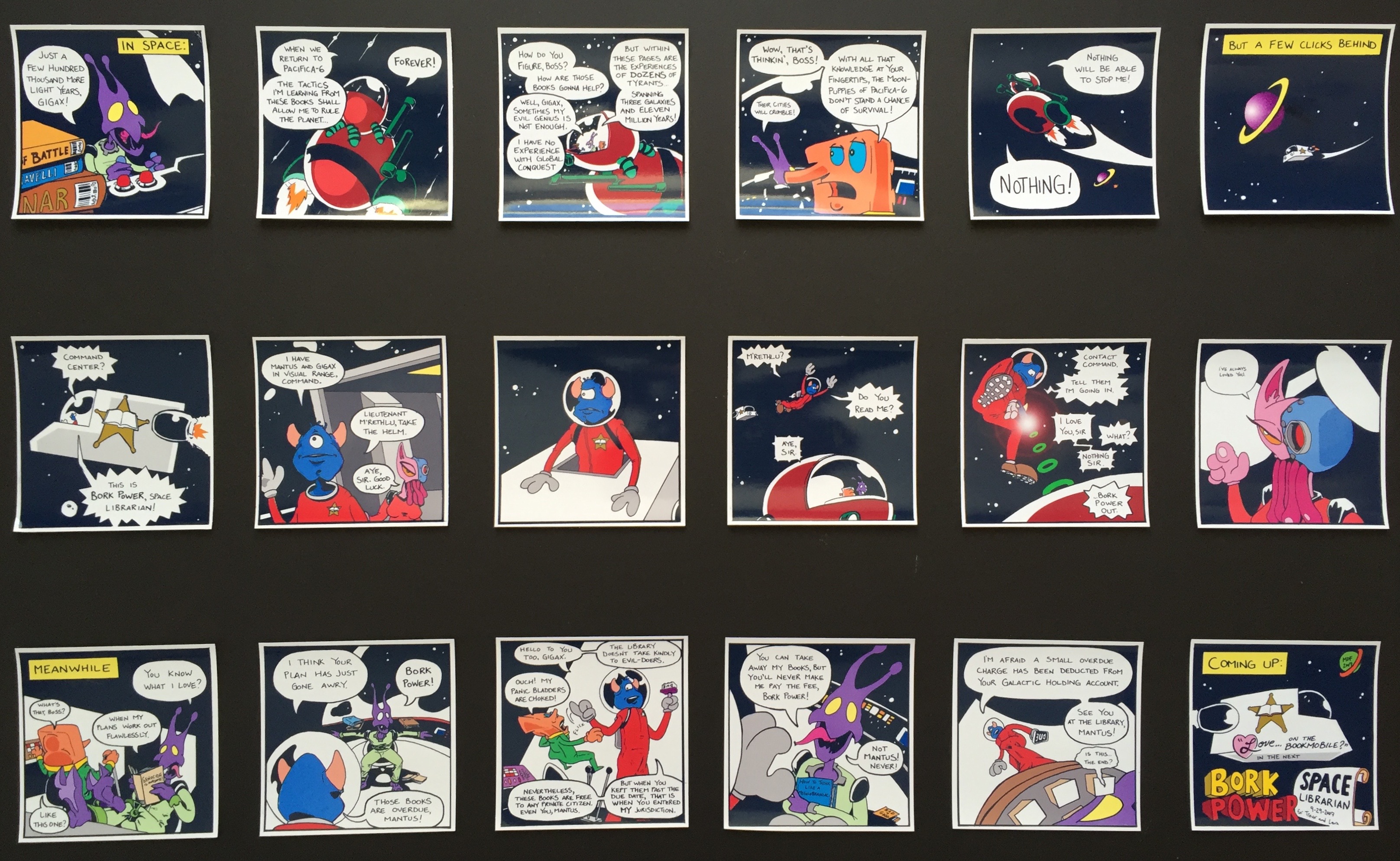
There are four other writers joining me this winter, and while it’s a smaller group than our summer cohort, it’s a mighty bunch of folks. Two writers are returning members: Lisa, my coworker, office-mate, mother, and micro-moment finder; and Robert, my coworker, office neighbor, father, and guitar-playing blogger. And two writers are new: Anne H. (not my former student and contributing blogger Anne D.), my coworker, office-mate of Robert, and fellow DePaul University grad school alum; and Matt, the man who, in addition to writing and drawing amazing comics, creating art, and writing, gave me and Trevor one of the best wedding presents ever:

A comic-fied version of our love story (this is seriously how it started...) by the man who was there from the start

A comic-fied version of our love story (this is seriously how it started…) by the man who was there from the start

So, now that everyone is introduced, let’s get to the writing. Below is a list of everyone’s goals for the next four weeks. I’ve included the big picture and first week goals together, since our group is small. We’ve all set solid goals for ourselves, and I’m excited to get started.

Winter Writing Goals:

  • Anne: My self assigned project will be to read the Burroway book [Imaginative Writing by Janet Burroway] and make notes. I’ve been making notes from other materials also. But the January assignment is Burroway.
  • Laura: My overall goal is to finish a story. I know that sounds vague, but I’ve got one unfinished project that I’ve been tinkering with for years, and two that I’ve been thinking about but haven’t started (one that I foresee as a longer piece and one that could be as short as a couple thousand words). I’d like to finish one of these three projects by the end of the month. So, my first week goal is to figure out which of these three I’m going to work on, and then to spend at least four pomodoros this week working on writing for that piece.
  • Lisa: My overall goal is to write one story. During week one I hope to finish five pages.
  • MattBig picture is simply to have a readable first draft of my book by the end of January, so each week will be devoted to another round of editing on different parts. Week one will be focused on the novella contained within the book (title of this section is “The Liminal Man”). Week one will be reviewing some old story notes and going through “The Liminal Man” one more time. (The story is about 89,000 words so I think that’s enough for week one!) [I agree with you, Matt]
  • Robert: [Robert is continuing to work on his second novel] My goal is 250 words a day, so that’s 1750 for week 1 and 7,000 for the four weeks. Let the games begin!

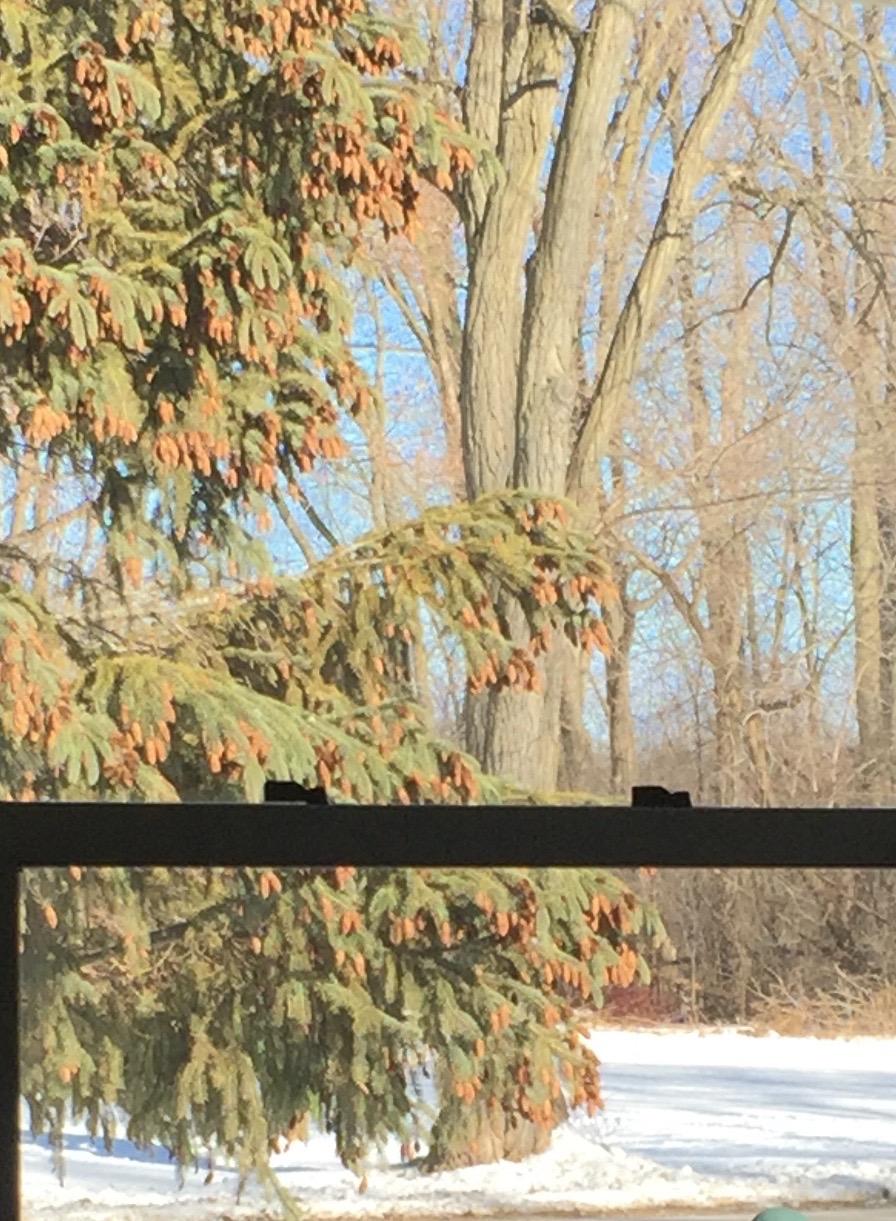
And now, I want to share a short post from Flavorwire, my favorite pop culture list maker. Last April they posted “20 Great Writers on Motivating Yourself To Write, No Matter What” to usher in the spring writing season. Although we’re currently ushering in a winter writing season, and our view-through-the-window inspiration is leafless trees and winter-white skies rather than budding flowers and singing sparrows, these writers — people like (one of my favorites) Lorrie Moore, Octavia Butler, and Franz Kafka — have good things to say about getting down to the business of writing.

So read their words, get inspired, and then get to work.

My winter view

My winter view

Winter Writing Project

This past summer I ran an online writing group for anyone interested in having a group of writerly friends (and acquaintances and strangers) holding them loosely accountable for their own writing projects. The projects our group worked on over the summer ranged from outlines and short story revisions to literary agent query letters and academic articles. And everyone got something done, which was the goal.

And because of how well it went (and how much fun I had running it), I’m hosting a shorter, four-week session this winter to help everyone chase away the post-holiday sugar withdrawals and start the new year with some solid writing productivity. The group is open to anyone who’s interested; it will run January 4 through February 1, with goals due to me each Sunday and posts going up here on the blog each Monday. I’ll also be welcoming guest posters, so keep that in mind, too!

If you’re interested, let me know in the comments section below (if we’ve never met), contact me through Facebook or Twitter, or send me an email (if we are email acquainted). You can read the first week’s post from the summer writing group or look through all of them right here.

Happy holiday writing planning!

Summer Writing Project Completed!

The Lake Projects eight-week summer writing project wrapped up last week, and it was a success! Some of our participants checked in for one last time with a final project statement. Here’s what they had to say:

Anne: I didn’t get what I wanted done this session mainly because life kept turning too chaotic for me to be able to write anything. I did get something written back in June but once July hit everything went down hill. (Anne wrote our week four guest post, and she did a lot of journaling, so, Anne, I think you did a great job)

Bev: I did pretty much finish my journal of my vacation (26 pp), did four blog posts on it, tweaked my query letter, and got potential agents in a spreadsheet.
My Big Picture goal is to get my memoir published, continue my letter writing, and start working on the next memoir from the 15 months I lived in Logan, UT, tentatively titled In the Shadow of the Temple. (Bev wrote our week six guest post; make sure to follow her blog, Fiacre’s Spade)

Laura: I didn’t reach my “big picture” goal (to finish a short story and start another), but I got a lot of work done on a story I started years ago, and I’m almost finished with the first draft. I wrote a lot of blog posts this summer, and that’s thanks to this group. On a whole, I feel great about the writing I did and I loved having a group to be accountable to. (Keep following the Lake Projects blog right here!)

Lisa: I can’t really remember what my big picture goal was for this summer session. I think I wanted to work on a few chapters of the children’s novel I’ve been wanting to start and I wanted to revise an old story. I never actually got to the story, but I did write the beginning of the novel that I’ve thinking about forever. That’s a pretty big accomplishment. I actually got words on paper and started fleshing out some characters. Wow. More importantly, I’m really excited to continue working on this, which is amazing. So, I’d consider this summer a success! Woo hoo! (Lisa wrote our week eight guest post. Good job, Lisa!)

Mike: I didn’t achieve my big picture goal from the start of the group, but I’m happy with the progress I made. It’s been a while since I tried to break up the writing process into manageable chunks (outlining, drafting, dividing-and-conquering on edits), and I was successful at those parts. I’ve also never tried to meld what I thought were two separate stories together and not let the seams show too much, and I think I’m closer to a finished product with that than I would have expected otherwise. The bonus was this past weekend, while cleaning out old files in preparation to pack up and put our house on the market, I found two pages of a draft version of one of the two stories with which I was working. I don’t remember writing them, but they actually function quite well within the revised version I have now (and provide dialogue and do a lot of connective work that I was missing), so I have even more material to edit together than I thought. I even have a possible new title, but I’ll hold off on sharing that till the draft is done, and I can make a careful decision on that. (That’s big progress! Read stories about Mike and his family’s experiences with Rett Syndrome on his blog, The Big Deal – Living With Rett)

Robert: I could only participate in the last week, but I exceeded my goal. I planned to write 2,000 words this week and I wrote 3,565. Yay! (Follow Robert’s progress on his writing blog, ROBBLOG)

I asked our group if they’d be interested in a shorter session, four weeks, beginning after the new year. I know that after the fall semester ends and the holidays wrap up, I’m going to want something to motivate me, and I thought others might feel the same way. And the writers are interested, so it will run! Mark your calendars and let me know if you’re interested in participating!

Coming Soon: Winter 2016 Online Writing Group, Monday January 4, 2016 – Saturday, January 30, 2016

Time to Get Lost

Group member Lisa is a colleague of mine in the MCC English Department and my office-mate on campus. In addition to being an excellent tea-drinking pal, Lisa co-advises the campus creative writing club with me, she is a fellow super-fan of The Walking Dead, and she’s a talented writer and has been published in The Florida Review, Black Warrior Review, and Mid-American Review.

When Lisa isn’t teaching, raising her three smart and gorgeous kids, or watching The Walking Dead, she’s finding “micro-moments” to write. Here’s how she does it.

This is a guest post from Lisa Crizer, a member of this summer’s Online Writing Group:

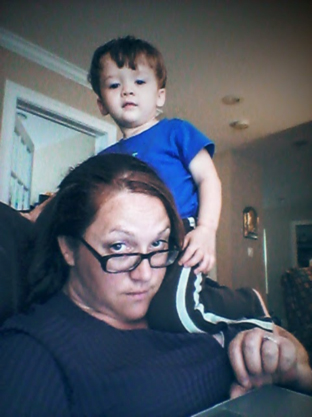
Lisa and Eli

I grew up in a loud family, to say the least. We discussed everything, and to the outsider I’m sure our conversations seemed like complete chaos. We watched a lot of TV, too. I’m completely comfortable with the dull background hum of daytime programming.

I like my surroundings loud and lively. I treasure the laughter and giggles that usually fill our rooms. I’m even learning to decipher the screams and squeals of the ever more frequent arguments between my girls. We are living life, with all of its sticky hands, mosquito bites, and nerve-sizzling mayhem.

Lately, however, days filled with hours of swimming and running around in the sun have led to late summer bedtimes. I love seeing my kids passed out in the corner of the couch, faces dirty from a day of fun. But, these later bedtimes have a sinister side effect — less time for me.

Our oldest daughter used to put herself to bed at 7:30. She still does. For years, my husband and I were spoiled with three hours each night all to ourselves. We were time-rich fools binge watching series on Netflix, having adult conversation, and doing crazy things like going to Target alone. Two children later and we are in a completely different boat; a completely different rickety old canoe in a deep, tumultuous ocean of constant companionship.

I never dreamt I’d seek out quiet; envy people dining alone at a restaurant, walking solo on the bike trail, or even just driving alone in their car listening to the radio. This summer has reminded me how important it is, as a writer, to have some solitude; time to think, make up scenarios, plan out conversations, flesh out characters.

So, what can I do? How can I rediscover this time and allow my mind to wander?

I wish I knew. I wish I had some great, disciplined plan where I would wake up every day a few hours before the kids and write. But, I don’t.

What I do have are “micro-moments”. Those precious instances where the TV is off, or the kids fall asleep in the car and I can finally turn off the Care Bears DVD. Or, the afternoon I’d been looking forward to for years, when I took my oldest to the bookstore and she read while I worked.

These “micro-moments” are hard to plan, and sometimes even hard to recognize. But right now they’re all I’ve got and I’m working hard not to waste them scrolling through my Facebook feed. If I can learn to appreciate these bits of calm, and string together all of these tiny specks of quiet time, I might just be able to get lost again once in a while.

We can all find these moments — we just have to look for them. Thanks, Lisa, for the reminder!

Week Eight: Online Writing Group

It’s the eighth and final week of the Summer 2015 Online Writing Group!

This is our last week of the Lake Projects Online Writing Group!

Here are Everyone’s Week Eight Updates & New Goals:

  • Anne: I am hoping for this week to have a good amount of research done in my journal. I am not sure if I will be able to make my eight week goal, as life has seriously been blocking the way lately. I am hoping to have something done by the end of the week.
  • Anuar: No update
  • Bev: I got twelve pages or so written about my vacation last week. For this week, I am going to send query letters to agents. Really! I mean it! At least four. Swear to God! (You will do it, Bev!)
  • Bonnie: No update
  • Curt: No update
  • DonnaNo update
  • Laura: I must finish my short story this week; I must, and I will!
  • Lisa: I’m hoping to write two pages this week!
  • MaryI didn’t write anything for two weeks because of some personal things, so for our last week I want to write a blog post about that.
  • Mary MargaretNo update
  • Matthew: No update
  • Mike: I made more progress on the first half of the draft version of the story but didn’t finish it. I still need to work on some of the connecting scenes and dialogue to get things coherently to the final scene of the story, which will be my goal for this week.
  • Robert: Been back from Hong Kong for a week, getting the jet lag out. Haven’t done any writing — we’ve had guests with us until today. I hope for this next week to get 2,000 words written. (Welcome back, Robert!)
  • Samantha: No update
  • Steve: No update

 Check back Wednesday for a guest post from Lisa!

Week Seven: Online Writing Group

It’s the seventh week of the Summer 2015 Online Writing Group!

We’ve got two weeks left in our online writing group! OH MY GOD!

We didn’t have a guest blogger this week, and a few of you got me posts after Sunday, so I’ve posted this a bit late. Are you disappointed? Too bad, suckers.

Here are Everyone’s Week Seven Updates & New Goals:

  • AnneMy goal for this week is going to be something simple: I want to go through my old journal entries and see if there is anything there to add to and improve. I have some things I wrote during my time at Columbia that I want to revisit as well. I’m going to be starting a new job this week so I’m going to have to rework my schedule a bit and see how the writing goes this week. As of right now, it’s up in the air and whatever happens this week, happens, writing wise I mean. (Hope the job is going well, Anne!)
  • Anuar: My goals for week seven are the same to add three more chapters to my book and I’m a bit behind but I’ll try to write more often over this last two weeks.
  • Bev: This week I’m going to keep a journal of my trip to the little cabin near the Boundary Waters north of Grand Marais, MN for another edition of Bev and Jane’s excellent adventures.
  • Bonnie: No update
  • Curt: No update
  • DonnaNo update
  • Laura: I want to get two more blog posts done this week — a short one about the play and a longer one about my favorite band that I’ve been thinking about for weeks now. I’ve also got an estimated four to six pages left on the story I’m writing, and I’d like to finish that this week.
  • LisaOkay, I’m going to say two pages. That’s all I’m shooting for.  🙂 (That’s enough, Lisa!)
  • Mary: No update
  • Mary MargaretNo update
  • Matthew: No update
  • Mike: I have the same objectives as last week (to flesh out the first half of the story draft), but not out of total slackerness. I wound up spending more time on the second half of the story and its climactic scene instead, so progress happened.
  • RobertNo update
  • Samantha: No update
  • Steve: No update

I couldn’t decide if I should use this week’s post as a list of links or a list of prompts, so you’re getting both!

The following is a list of links that, as writers and readers, you might find interesting:

And now, here’s your list of writing prompts (these are non-fiction, but you could like adapt them for fiction if you wanted to):

  • “Write a memoir about a job you have held. Show (and tell) why this job did not lead to a life-long career” (Burroway 250).
  • “Make a list of family mysteries or things you feel uncertain about in your family history. Interview someone in your family who might be willing to fill you in” (Roney 105).
  • Write about something that’s stuck in your craw — a graduate school professor of mine, Larry Heinemann (who is wonderful and everyone should read Paco’s Story [and every Chicagoan should read Cooler by the Lake]) gave me this assignment once, and whenever a student is stuck, I repeat it. What idea, moment, argument, or observation have you not been able to shake for the last few days or weeks? What’s stuck with you? Write about it. Now.
  • Write 250 – 500 words about your worst fear. It doesn’t have to be rational (I’m scared of sharks and have been known to get the terrors for a few seconds while in a swimming pool); it doesn’t have to exist (unicorns, vampires, narwhals [wait, narwhals exist, nevermind]). But why does it scare you?

Okay, got enough? Now, get to writing! Next week is our last week; we’ll have one more list of goals, a guest post from Lisa, and more amazing content to keep you procrastinating long into the wee hours of the morning!

*Burroway, Janet. Imaginative Writing: The Elements of Craft. 3rd Ed. New York: Pearson/Longman, 2011. Print.

Roney, Lisa. Serious Daring: Creative Writing in Four Genres. New York: Oxford, 2015. Print.

*Burroway is a writer whose textbook I use in my creative writing class and whose textbook I used when I was an undergraduate learning the craft. Her approach is practical and straightforward, and I recommend reading her book for useful tips and an excellent anthology of poetry, prose, and drama.